 Tech Trends Daily

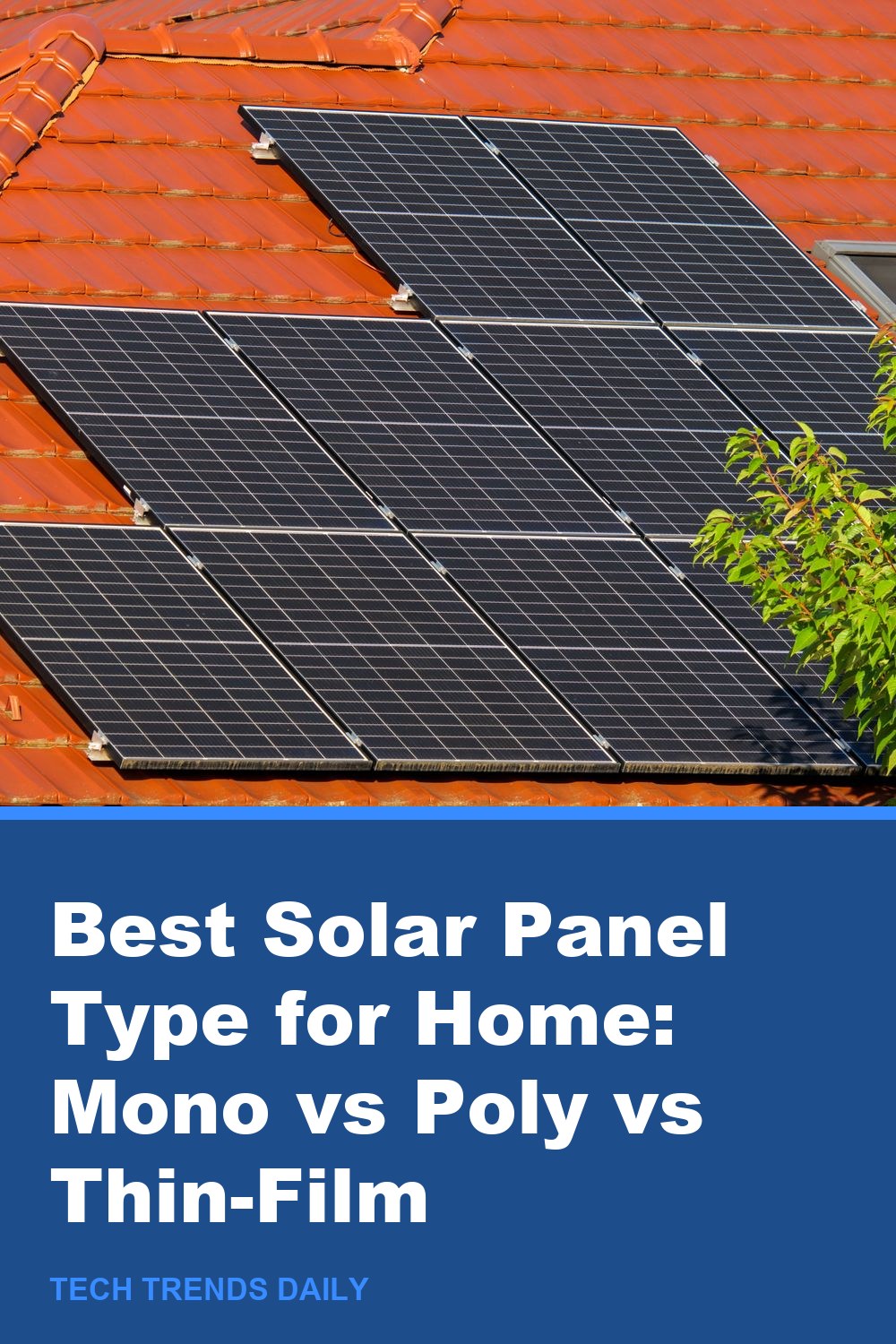

- Monocrystalline is the default choice for most pitched roofs because it makes more power per square foot than polycrystalline or thin-film.
- The average US install was $3.36 per watt in Q2 2026, and the 30 percent federal tax credit ended for systems finished after December 31, 2025.
- Compare quotes by projected yearly output and total price, not panel wattage, and read the performance warranty before you sign.
For most homes, monocrystalline panels are the best type: they make the most power per square foot, and that matters on a roof already crowded with vents, chimneys and skylights. Polycrystalline can be cheaper where you can still find it, but it needs more space. Thin-film is rarely the right call for a standard pitched roof. This matters now because, according to Engadget, the federal residential clean energy tax credit ended for systems completed after December 31, 2025, so the price you are quoted carries more weight than it used to.
Who this buying guide is for
It is for homeowners with a roof, a rough idea of their electric bill and a stack of installer quotes (or about to request them). If you rent, or your roof is shaded most of the day, jump to the portable power station option near the end.
Panel type is only one of three decisions. The other two are how much usable roof you have and what you want solar to do: cut your monthly bill, or keep the fridge and Wi-Fi running during a blackout. Those goals lead to very different systems and budgets.
Monocrystalline, polycrystalline and thin-film compared
Engadget explains the basic split. Monocrystalline cells are cut from a single crystal of silicon and pack a higher power density. Polycrystalline panels may cost less where they are still sold, but they take up more room to produce similar power. Thin-film panels use thin layers of photovoltaic material, and some are light and flexible enough for unusual mounting.
| Panel type | Power per square foot | Price tendency | Best fit |
|---|---|---|---|
| Monocrystalline | Highest | Varies by model and quote | Most pitched roofs, especially when space is limited |
| Polycrystalline | Lower than mono | Can be cheaper, where still available | Large, open roof where space is no issue and a good deal exists |
| Thin-film | Needs more area for comparable output | Depends on the quote | Unconventional mounting; rarely a first choice for a standard roof |
One more option is solar shingles, which replace roofing material instead of sitting on top of it. Engadget notes they cost roughly twice as much per watt as standard panels, at $21 to $25 per square foot installed. On a 2,500-square-foot home that works out to $52,500 to $62,500 before incentives. They are a looks-first purchase, not a value purchase.
Specs that matter and marketing that doesn't
Watch for the cell technology names on monocrystalline panels: TOPCon, HJT and PERC. Engadget says most are refinements of the same silicon rather than new materials, each with its own small gains. Do not choose on the acronym alone.
Look at module efficiency and wattage together. Engadget's example: Qcells' Q.TRON BLK M-G2+ delivers 440W at 22.5 percent module efficiency, while Tesla's 420W residential module is at least 20.5 percent efficient. Higher efficiency means more power from the same area, but panel size also changes the comparison. Neither spec sheet tells you what you will actually produce on your roof.
Real-world output depends on things the brochure skips:
- Heat: panels get less efficient as they warm up.
- Shade and orientation: both can dent yearly output noticeably. Engadget's second piece adds that panels usually go on unobstructed, south-facing roofs.
- Bifacial panels: they catch reflected light on the back, but the benefit depends mostly on how they are mounted and the surroundings.
It is the same logic as buying a laptop or a TV: the headline number sells, the fit decides. Our guides on choosing a laptop without overpaying for specs and on which screen resolution is enough make the same point.
What solar costs and how to compare quotes
The Solar Energy Industries Association reported an average US residential price of $3.36 per watt in the second quarter of 2026, per Engadget. A typical home system lands between $20,000 and $27,000 before incentives. One Engadget editor paid just over $24,000 for a 5.1kW system including inspections and permits. At the benchmark rate that size would come to roughly $17,100, so real quotes can run well above the average.
Compare quotes on two numbers: projected annual electricity production and total price. Ignore the wattage printed on the modules. Then check what is bundled in:
- roof repairs
- permits
- inverter
- warranty coverage
Solar panels usually lose output slowly rather than failing suddenly, so the performance warranty can matter as much as the sticker price.
Sizing your system and checking your local math
Engadget suggests the 20 percent rule: build in enough capacity to produce about 20 percent more than your household normally uses, as a cushion for dim days. If you use 100 units of power, aim for about 120.
Then check three local factors, since they can change the payback more than the panel type does:
- Your electricity rate. Engadget names Hawaii, Maine, Massachusetts, California, Alaska, New York, Rhode Island, New Hampshire, New Jersey and Connecticut as the ten most expensive states. Outside those, a small home with efficient appliances may see little change in its bill.
- Net metering. The best programs credit surplus power at the same retail rate you pay. Others use buyback or net billing at a lower rate. Programs differ by state and are not available everywhere.
- Roof condition. If the roof is old, you may need a new one first, which Engadget says can cost from $4,000 to more than $35,000.
Backup power and portable alternatives
Panels alone do not keep your lights on in a blackout. You need a battery. Engadget puts a single-battery system (lights, fridge, Wi-Fi, some outlets) at $10,000 to $16,000, and whole-home multi-battery backup at $22,000 to $40,000, plus maintenance.
If backup is the real goal, a portable power station is far cheaper. Engadget lists Anker SOLIX, Jackery, BLUETTI and EcoFlow as makers of units that charge from one or more compatible panels and run a limited number of appliances. It will not replace a rooftop array, but it covers the essentials.
Buy now, wait or skip
Buy now (monocrystalline) if you have a sunny, mostly unshaded roof in good shape, you pay a high electricity rate, your utility offers net metering, and you plan to stay long enough to pay the system off. Pick on yearly output per dollar and warranty, not on the brand with the shiniest efficiency figure.
Wait if your roof needs replacing soon, if you might move before the system pays for itself, or if you are only guessing at your savings. Engadget warns that an unpaid loan or power purchase agreement can complicate a sale: the buyer must take over the contract or you pay off the balance. A solar lease also requires buyer approval that can take up to two months, and a lender may refuse to close while the leasing company's lien (a UCC-1) is still active.
Skip rooftop solar if your bill is low, your roof is heavily shaded or your area is mostly overcast or very hot. Skip thin-film for a normal pitched roof, and skip solar shingles unless looks justify the price. If outages are your worry, a power station is the more honest purchase.
Steps before you sign a solar quote
- Pull 12 months of electric bills and note your yearly usage.
- Measure usable roof space, minus vents, chimneys and shade.
- Ask your utility about net metering or net billing, and look up state and local incentives.
- Get several quotes and compare projected yearly output and total price, including permits, inverter and roof work.
- Read the performance warranty, and ask what happens to the contract if you sell.
- Decide whether you want backup power, and price the battery separately.
For a printable version of this list, the Honest Toolkit solar panels checklist is a handy companion when you sit down with installers.
As an Amazon Associate I earn from qualifying purchases: if you buy through these links I may earn a small commission, at no extra cost to you. Each link opens a search on the Amazon store for your country.
Watch or listen to this episode
Sources
- Engadget: Which solar panel type is best for your home?
- Engadget: The drawbacks of adding solar panels to your home
Photo: Vladimir Srajber / Pexels

I'm an Italian creator who builds apps, games and websites. I run Tech Trends Daily with the help of AI tools: every article starts from the sources linked above, and I check what goes out. I'm not a doctor, a lawyer or a financial adviser. Spotted a mistake or have an idea? Write to me.
Instagram @spartaco_94_My websiteWrite to meAbout this blogWritten by Ciro Irmici (Ciro Simone Irmici), with the help of AI tools. Ciro Irmici's website











 Simulated Lives: Are We Already Living in a Matrix?
 The Physics of Space Travel: Exploring Faster-Than-Light Travel
 Speed Reading: The 3-Book Bundle





